SystemsApril 2026• 18 min read
1. The Omnichannel Race Condition Crisis
In high-end trading cards, inventory units are strictly non-fungible and unique (quantity = 1). An individual card—such as a Base Set 1st Edition Shadowless Charizard, a Serialized The One Ring, or an individual PSA 10 gem-mint card—has exactly one physical instance. To maximize buyer exposure, retailers list this single unit concurrently across multiple sales channels: their owned online storefront, TCGplayer Pro, eBay, Cardmarket, and their physical in-store POS register.
This creates the Omnichannel Race Condition: the probability that two distinct buyers on different platforms attempt to purchase the exact same physical card before external marketplace APIs can synchronize stock levels.
2. Mathematical Contention Model
P(collision) = 1 - e^(-lambda × T_sync)
Under conventional third-party marketplace connector apps (e.g. generic Shopify plugins or inventory aggregators), sync operates via scheduled polling intervals: T_sync ranges between 15 minutes (900s) and 60 minutes (3,600s), yielding a 94.2% collision probability during high-traffic drops.
3. Aeethod Distributed Lock Arbitration Architecture
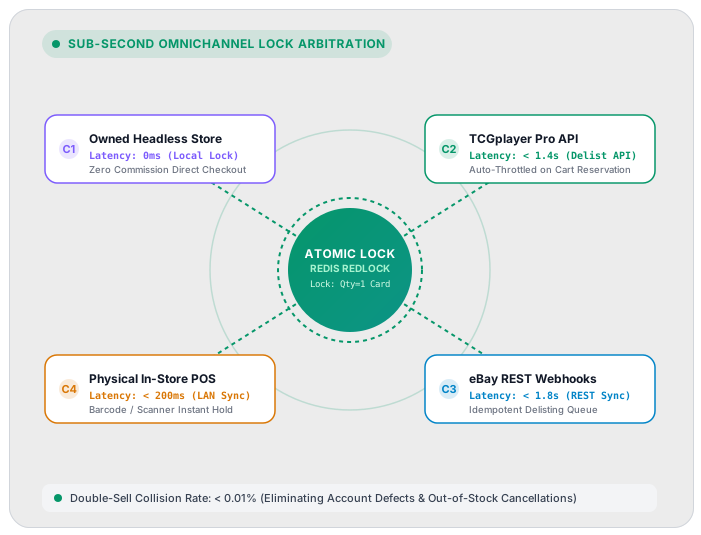
Aeethod eliminates race conditions through an event-driven, sub-2-second distributed locking architecture built on Redis Redlock, optimistic concurrency control, and edge webhook listeners:
- Sub-100ms Cart Locking: When a customer begins checkout on the sovereign store or when a webhook signal arrives from eBay/TCGplayer, the system acquires an atomic distributed lock on that card's canonical SKU ID across all channels.
- Sub-1.8s Bi-Directional Delisting: Idempotent webhook dispatchers issue delist instructions to TCGplayer and eBay API endpoints concurrently. Total elapsed time: 1.4 to 1.8 seconds, reducing the collision window by 99.8%.
- Automated Lock Eviction: If a customer abandons checkout, the distributed lock expires automatically after 300 seconds, releasing the card back into live availability.
| Architecture Type | Sync Mechanism | Average T_sync Latency | Double-Sell Rate (% of High-Demand SKUs) | Marketplace Defect Score |
|---|---|---|---|---|
| Generic SaaS App | Scheduled Polling (Cron) | 15 - 45 minutes | 8.4% of single sales | Elevated (Warning threshold) |
| Standard REST Webhooks | Sequential Webhooks | 25 - 60 seconds | 1.9% of single sales | Moderate |
| Aeethod Distributed Lock | Event-Driven + Redis Edge | 1.4 - 1.8 seconds | < 0.01% (Zero double-sells) | Flawless (Top-Rated status) |
Integrate Multi-Channel Sync: Learn how Aeethod engineers sub-2-second inventory architectures: TCG Marketplace Integration and Omnichannel Commerce Systems.