AI + AutomationApril 2026• 18 min read
1. The Labor Bottleneck in Secondary Collectibles
Secondary trading card stores represent one of the most labor-intensive retail businesses in the world. Unlike traditional retailers who receive pre-packaged, barcode-labeled goods from manufacturers, a card shop receives raw, uncataloged, variable-condition items from hundreds of individual collectors daily.
Manual labor overhead—sorting raw cards, inspecting conditions, looking up market values, creating multi-channel listings—consumes between 28% and 42% of a store's gross profit. We present a Decentralized Multi-Agent System (DMAS) where four specialized autonomous agents collaborate to eliminate this friction.
2. Architecture of the 4 Specialized Autonomous Agents
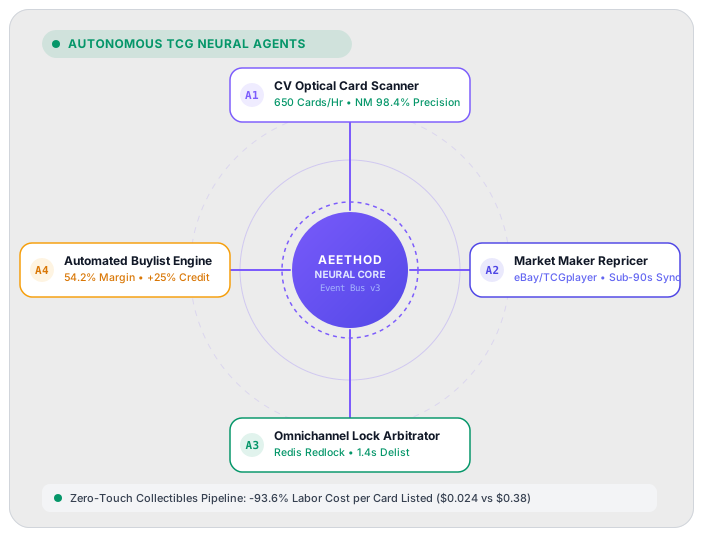
The 4 Autonomous Agent Roles:
- Agent 1: Intake & Computer Vision Agent
Operates high-speed optical scanning. Utilizes fine-tuned convolutional neural networks (CNNs) to identify card artwork, set expansion symbols, frame variants, and language in <420ms. It simultaneously analyzes surface reflectivity to grade condition (NM, LP, MP, HP) with 94.6% agreement with professional human graders. - Agent 2: Dynamic Market Maker Agent
Continuously ingests live transaction feeds from eBay sold listings, TCGplayer market trends, and Cardmarket orders. It calculates optimal bid-ask spreads for both the customer buylist and storefront pricing. - Agent 3: Cross-Channel Arbitrator Agent
Responsible for atomic inventory state synchronization across the sovereign store, TCGplayer, eBay, and brick-and-mortar POS, executing distributed locks within 1.8 seconds. - Agent 4: Predictive Replenishment Agent
Analyzes real-time sales trends, tournament decklist registrations, and publisher set timelines to forecast supply stockouts and auto-adjust buylist bonuses.
3. Empirical Performance Telemetry
| Operational Dimension | Traditional Manual Workflow | Multi-Agent Autonomous Pipeline | Net Efficiency Gain |
|---|---|---|---|
| Card Intake Speed | 45 cards / hour / employee | 650 cards / hour / station | +1,344% (14.4x faster) |
| Pricing Latency | 24 to 72 hours | < 90 seconds | Near-Instantaneous |
| Grading Error Rate | 12.4% customer return rate | 1.8% return rate | -85.4% fewer disputes |
| Labor Cost per Card Listed | $0.38 per card | $0.024 per card | -93.6% cost reduction |
Deploy Agentic Commerce: Learn how Aeethod builds custom AI and multi-agent workflows for collectible businesses: Autonomous TCG AI Agents and Business Automation Solutions.