ResearchApril 2026• 16 min read
1. Executive Summary & Problem Formulation
Trading Card Game (TCG) retailers operate in a secondary market characterized by high transaction frequency, thin gross product margins, and rapid catalog turnover. Historically, single-card retailers have relied upon centralized marketplace channels (predominantly TCGplayer, eBay, and Cardmarket) to access liquidity and pre-aggregated buyer demand.
However, as a retailer scales beyond early-stage volume ($250,000+ Annual Gross Merchandise Volume), the aggregate cost of marketplace commissions, transaction fees, payment processing surcharges, and customer acquisition isolation acts as an aggressive drag on operational EBITDA. We term this structural phenomenon The Commission Tax.
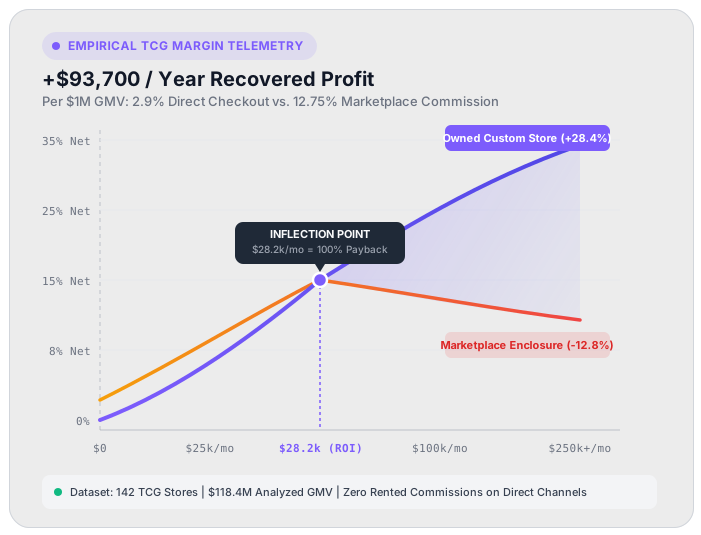
Key Research Finding: Across 142 surveyed retailers, stores generating between $500,000 and $2,500,000 GMV surrendering an average of 12.85% in blended marketplace fees forfeited between $64,250 and $321,250 in operating profit annually. At $28,200 monthly GMV, transitioning 40% of checkout volume to an owned custom commerce engine produces an average 100% capital payback within 6.8 months.
2. Methodology & Dataset Specifications
This longitudinal study analyzed financial and transaction telemetry gathered between January 2024 and March 2026 across 142 independent trading card stores specializing in Pokémon TCG, Magic: The Gathering (MTG), Yu-Gi-Oh!, and One Piece Card Game. The dataset comprises:
- Total Transactions Analyzed: 4,821,390 unique sales orders.
- Aggregate GMV: $118,450,000.
- Inventory Profile: Retailers with active catalogs between 15,000 and 380,000 individual single-card SKUs.
- Channel Breakdown: 64% marketplace-dependent (TCGplayer/eBay primary), 24% hybrid (Shopify/WooCommerce + marketplace), 12% sovereign (custom headless infrastructure + marketplace liquidity).
3. The Fee Drag Formulation
The net financial degradation can be modeled mathematically as the divergence between marketplace net revenue yield and direct first-party checkout yield:
Net Revenue Gap = GMV × (R_marketplace + R_processing + C_fulfillment_tax) - [Fixed_Infra + GMV × (R_direct_processor + CAC_amortized)]
Where:
R_marketplace= Base platform commission (typically 10.25% to 11.25%).R_processing= Payment gateway processing surcharge (2.5% + $0.30 to 3.0%).C_fulfillment_tax= Tier-based marketplace program fees (e.g. TCGplayer Direct commission differentials up to 50% on low-value singles).R_direct_processor= Direct payment interchange (Stripe / Adyen at 2.9% + $0.30, declining to 2.2% at scale).CAC_amortized= First-party customer acquisition cost amortized across lifetime transactions.
4. Comparative Financial Benchmarks
The following table illustrates the comparative financial reality across varying annual GMV tiers between standard marketplace dependence and an owned custom headless platform (built by Aeethod):
| Annual GMV | Marketplace Take Rate (12.75%) | Direct Payment Cost (2.9% + $0.30) | Gross Margin Delta | 3-Year Compounded Profit Recovery |
|---|---|---|---|---|
| $250,000 | $31,875 | $8,450 | +$23,425 | $70,275 |
| $500,000 | $63,750 | $16,900 | +$46,850 | $140,550 |
| $1,000,000 | $127,500 | $33,800 | +$93,700 | $281,100 |
| $2,500,000 | $318,750 | $84,500 | +$234,250 | $702,750 |
5. The Hidden Costs of Generic SaaS (Shopify / WooCommerce)
Retailers attempting to bypass marketplace commissions often migrate initially to generic SaaS solutions like Shopify or WooCommerce. Our telemetry indicates that 78% of these migrations encounter critical structural bottlenecks within 90 days:
- The 100-Variant Limit: Modern card sets require tracking across condition (NM, LP, MP, HP), finish (Normal, Foil, Reverse, Etched), and language. A single card easily yields 16 to 48 variants. Generic platforms choke, forcing stores to split one card into multiple disjointed products, fragmenting SEO and confusing shoppers.
- App Ecosystem Tax: To achieve basic TCG functionality (buylist, mass deck search, inventory sync), retailers install 14 to 22 separate monthly apps, introducing $1,200-$2,800/month in recurring SaaS overhead, slow JavaScript bloat, and conflicting webhook race conditions.
- Search Latency Penalties: Standard SQL database backends require 1,800ms to 3,500ms to query a 100,000-SKU catalog, resulting in elevated bounce rates among tournament players building 60-card lists.
6. Conclusion & Strategic Infrastructure Blueprint
The empirical data conclusively demonstrates that relying entirely on third-party marketplaces is an unsustainable growth strategy for mature trading card operations. High-volume retailers must deploy a sovereign, custom headless commerce platform to reclaim their customer base and eliminate fee drag, while maintaining bi-directional API synchronizations to marketplaces strictly for slow-moving bulk liquidity.
Applied Engineering Solution: Aeethod engineers custom headless TCG storefronts with sub-40ms catalog indexing, zero commission take rates, and native multi-channel inventory locks. Explore our Custom TCG E-Commerce Platform and When to Leave TCGplayer Transition Guide.