Store ArchitectureSeptember 2026• 10 min read
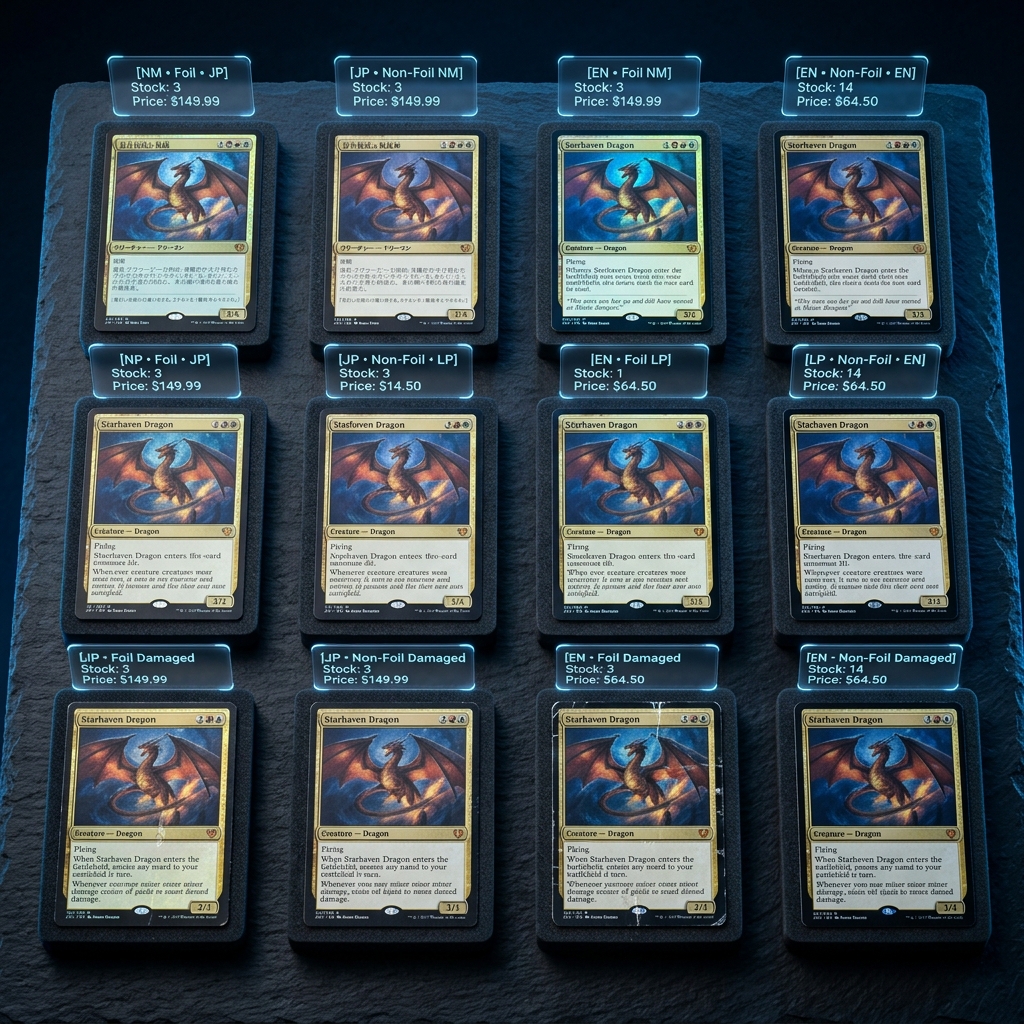
1. The Math of TCG Singles: Why Shopify Breaks Out-of-the-Box
Shopify was designed for standard retail: shoes with 3 colors and 10 sizes (30 variants). In the trading card world, a single card listing like Charizard ex from Pokémon 151 or The One Ring from Magic: The Gathering contains far more combinations:
- 5 Condition Grades: Near Mint (NM), Lightly Played (LP), Moderately Played (MP), Heavily Played (HP), Damaged (DMG).
- 3 Finish Types: Non-Foil, Traditional Foil, Reverse Holofoil.
- 4 Languages: English, Japanese, German, French.
- Graded Slabs: PSA 10, PSA 9, BGS 9.5, CGC Pristine.
Multiply 5 conditions × 3 finishes × 4 languages = 60 variants before even counting graded slabs, art variations, or printings! Add in first edition stamps or prerelease promos, and a single card easily exceeds 150+ variants.
Shopify enforces a hard, unyielding technical ceiling: every product is capped at a maximum of 100 variants. The moment you hit variant #101, Shopify rejects the listing.
2. The Ugly Workaround: Creating Multiple Duplicate Listings
To get around this limit, most card shop owners use third-party Shopify apps or manually split their catalog into fragmented product listings:
- Product 1: Charizard ex (Non-Foil)
- Product 2: Charizard ex (Holo Foil)
- Product 3: Charizard ex (Reverse Holo)
- Product 4: Charizard ex (Japanese)
While this bypasses the 100-variant limit, it introduces three severe operational disasters:
- Search Engine Cannibalization (SEO Ruined): Google hates duplicate, thin product pages. Instead of ranking one authoritative card page at the top of Google, search engines split your ranking power across 4 weak pages, allowing TCGplayer and eBay to outrank you on every card search.
- Frustrated Collectors: A collector searching your store has to click back and forth between multiple pages just to find which condition or finish you have in stock. If it takes more than two clicks, they leave your website.
- Catalog Bloat: A store with 20,000 singles suddenly balloons into 80,000 messy Shopify product records, slowing down your backend and making inventory counts a nightmare.
3. The Aeethod Solution: The Edge-Calculated Deep-Variant Matrix
At Aeethod, we engineered an architectural breakthrough for card stores: Master SKU Canonicalization with an Edge-Calculated Variant Matrix.
Instead of forcing every variation into a rigid Shopify database row, our custom Next.js storefront indexes conditions, finishes, languages, and graded slab certifications directly at the network edge.
- 300+ Variants on One Page: Every condition, finish, and language lives on a single, clean URL (e.g.
/pokemon/151/charizard-ex-199). - Sub-15ms Live Toggles: When a collector clicks from "Near Mint · Foil" to "Lightly Played · Non-Foil", the price, high-resolution photo preview, and exact stock count swap instantly in under 15 milliseconds—without reloading the page!
- 100% SEO Equity: Search engines index one authoritative, high-ranking product page with complete Schema.org structured data, capturing valuable Google organic search traffic.
4. How to Deploy This for Your Card Store
Whether you want to optimize your existing Shopify storefront or build a high-performance custom platform, Aeethod provides turnkey engineering:
- Shopify TCG Kickstart ($3,500 – $4,800): We configure a specialized variant application layer on top of Shopify that bypasses display limitations and cleans up your single-card presentation in 2–3 weeks.
- Custom TCG Commerce Platform ($7,800 – $9,800): Our flagship turnkey build. Completely removes Shopify's 100-variant ceiling, gives you 100% codebase ownership, sub-35ms card search, and 0% sales commission checkout in 4–6 weeks.
Ready to fix your store's variant bottleneck? Explore our commerce architecture or speak with an Aeethod engineer today.