Inventory SyncSeptember 2026• 9 min read
1. The Double-Sale Nightmare: An All-Too-Familiar Saturday Afternoon
It is Saturday afternoon at your card shop. The store is packed for a tournament, and a regular customer walks up to the counter and buys a Near Mint Mox Diamond or vintage Charizard for $450. You ring it up on your register and put the card in their hands.
Twenty minutes later, while you're sorting singles, your phone buzzes with a notification: "You made a sale on TCGplayer!" Your heart sinks. Someone just bought that exact same $450 card on TCGplayer before your inventory updated.
Now you're in a lose-lose situation: you have to message an excited buyer, cancel their order, issue a refund, and take a defect penalty against your TCGplayer seller metrics. If your cancellation rate exceeds 2%, your seller privileges get downgraded.
2. Why Legacy Sync Tools Fail: The 15-to-45 Minute Polling Gap
Why does this happen so frequently? Most card inventory tools (like standard Shopify apps, BinderPOS, or CrystalCommerce) rely on cron polling jobs:
- Every 15, 30, or 45 minutes, their server asks: "Did anything sell on eBay? Did anything sell on the POS?"
- If an item sells during minute 2 of a 30-minute interval, that card sits vulnerable on TCGplayer for the next 28 minutes!
- On high-volume release weekends or tournament days, this polling gap causes dozens of stockout cancellations and thousands of dollars in lost reputation.
3. The 2-Second Rule: Event-Driven Webhooks
At Aeethod, we engineered an architectural standard for trading card retail: The 2-Second Concurrency Rule.
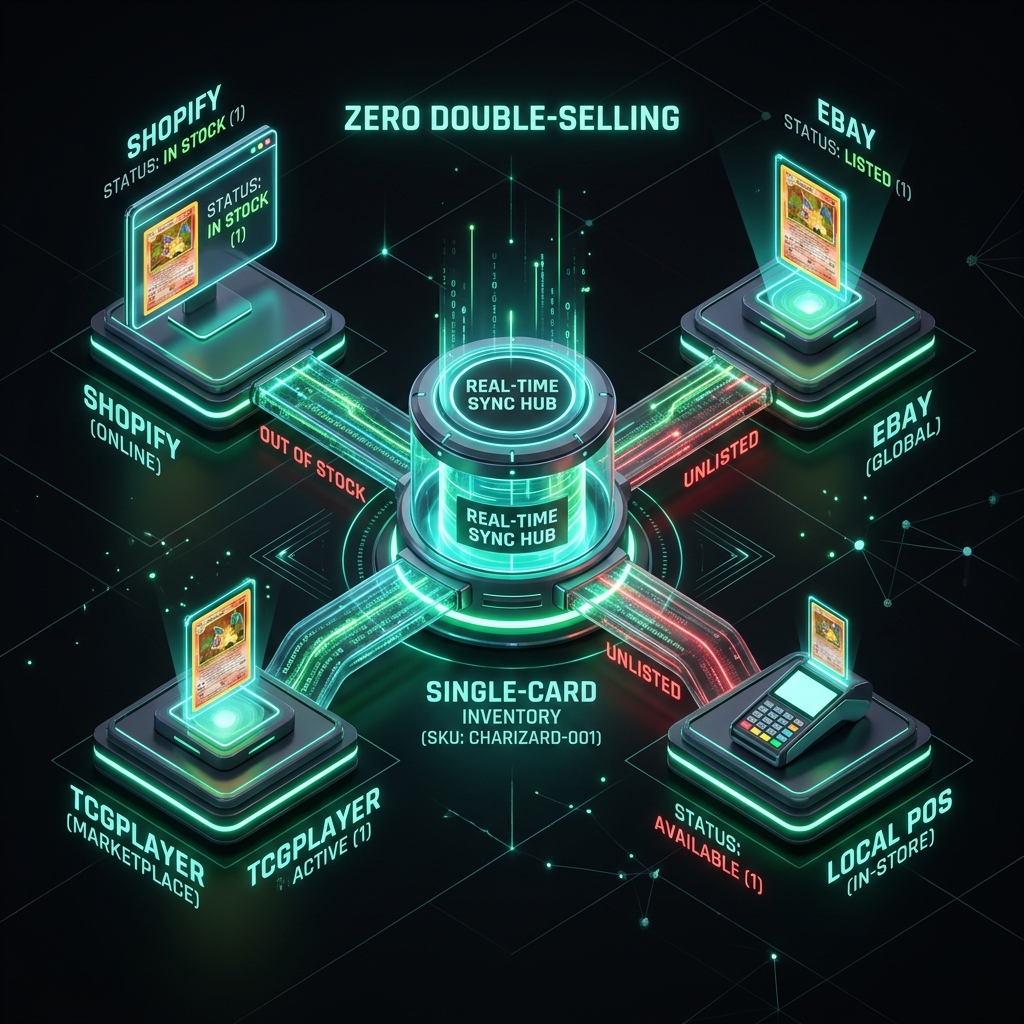
Instead of periodic polling checks, Aeethod uses an event-driven webhook mesh with distributed concurrency lock arbitration:
- Step 1 (Instant Event Trigger): The instant a barcode is scanned at your counter POS or a checkout webhook fires from your website or eBay, an encrypted payload broadcasts to our central lock arbitrator.
- Step 2 (Channel Auto-Delist): Within 1.8 seconds, our system dispatches API deletion payloads to TCGplayer, eBay, and your online storefront simultaneously.
- Step 3 (Reconciliation Confirmation): The SKU is decremented or delisted before any other buyer can complete checkout.
The result: zero double-selling, zero stockout cancellations, and 100% peace of mind.
4. Connecting In-Store Counter POS with Online Liquidity
Many local game stores keep their best high-value singles locked in display cases because they are terrified of online double-sales. By locking singles away from the internet, you lose 80% of your potential buyer audience!
With Aeethod's sub-2-second sync architecture, you can list your entire counter showcase on your website, TCGplayer, and eBay with complete confidence. When an in-store customer buys the card, it vanishes from the web before they even walk out the front door.
5. Turnkey Deployment with Aeethod
Our real-time omnichannel synchronization mesh is available as part of our turnkey packages:
- Advanced Omnichannel TCG System ($14,500 – $18,500): Turnkey delivery in 6–8 weeks. Includes custom storefront, customer buylist portal, and sub-2-second bidirectional synchronization across TCGplayer, eBay, Shopify, and counter POS.
- Standalone Integration Modules: Custom webhook pipelines engineered for existing card retail stacks starting at $2,800 – $4,200.
Eliminate double-selling for good. Explore our integration architecture or schedule a system consultation today.